
What Drives Commercial Millwork Lead Times
There's no single lead time for commercial millwork — it's set by scope, materials, the submittal-approval cycle, and shop schedule. Here's what actually moves the timeline, and how GCs and architects can protect it.
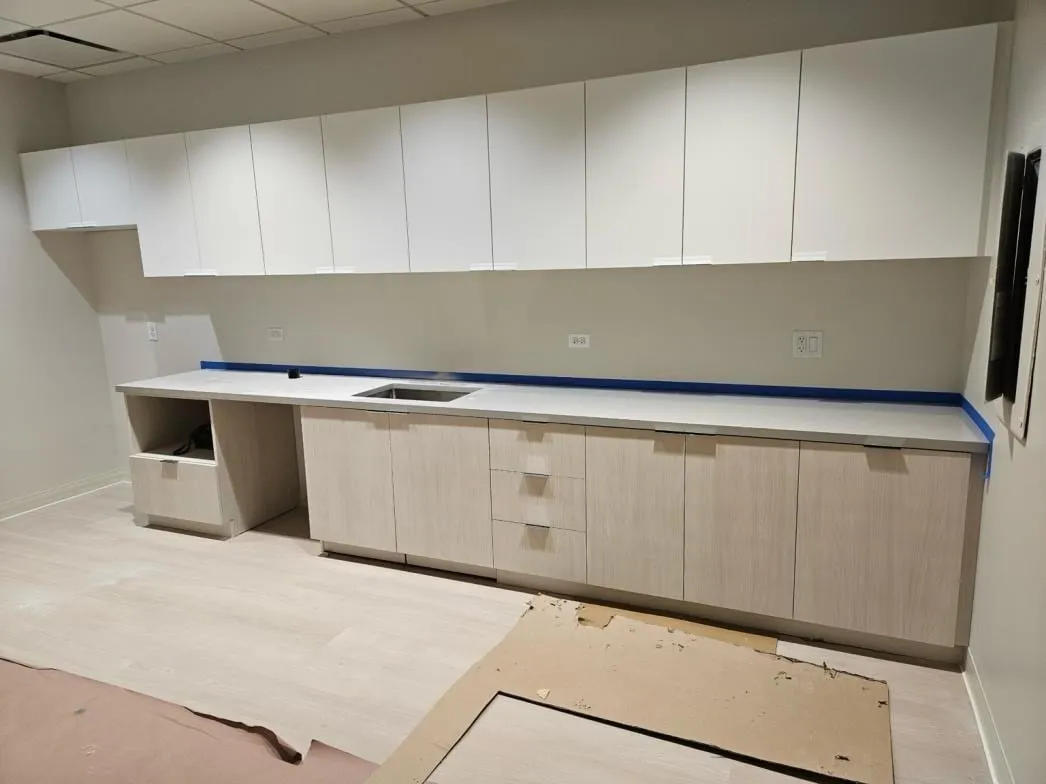
One of the most common questions we get is also one of the hardest to answer with a single number: what’s your lead time? The honest answer is that commercial millwork doesn’t have one fixed lead time — it’s set by the project itself. Two packages of the same dollar value can have very different timelines depending on scope, materials, and how fast approvals move.
Here’s what actually drives the schedule, so you can plan around the real levers instead of a guess.
1. Scope and quantity
The most obvious factor: how much there is, and how complex it is. A single reception desk moves faster than a full floor of casework, and a straightforward laminate package moves faster than feature-grade architectural millwork with detailed veneer matching. Repeatable, standardized casework fabricates efficiently; one-off, highly-detailed pieces take more engineering and shop time. Scope sets the baseline.
2. The approval cycle — usually the real bottleneck
This is the one most people underestimate. Fabrication can’t start until shop drawings and submittals are approved and finishes are selected. We produce coordinated shop drawings from the architectural set, submit them for review, and wait for sign-off before anything is cut.
If approvals move quickly, the timeline holds. If drawings sit in review for weeks, or finish selections aren’t locked, the whole schedule slides — not because the shop is slow, but because everything downstream (ordering material, cutting, finishing) is waiting on that sign-off. On most projects, the approval cycle moves the delivery date more than the actual building does.
3. Materials and long-lead items
Once approved, the shop orders materials — and some materials take longer to source than others. Standard plastic laminate and common substrates are readily available; certain wood veneers, solid surface, quartz and stone, specialty hardware, glass, and metal can be long-lead. If a specification calls for a hard-to-source product, identifying it early lets us order it in parallel with drawing approval so it’s on hand when fabrication starts, instead of becoming the thing everyone waits on.
4. Shop schedule and capacity
Like any fabricator, our shop runs a production schedule. A package that arrives approved and ready slots into that schedule; timing depends partly on what’s already in production. This is another reason early engagement helps — the sooner a project is in the queue, the better it can be sequenced. In-house CNC fabrication and finishing help us keep repeatable work moving efficiently, but no shop has infinite same-day capacity.
5. Delivery, site readiness, and install sequencing
The last stretch is delivery and installation, and that has to line up with the site. Millwork is crated in installation sequence and delivered when each area is ready to receive it. If the site isn’t ready — walls not closed, other trades not finished — the install waits, and finished casework shouldn’t sit exposed on an active site. Good coordination between the GC’s schedule and the millwork delivery keeps this from adding time at the end.
How to protect the timeline
The pattern across all of these is that most schedule risk lives in approvals and materials, not in the shop’s cutting and assembly time. So the things that protect a millwork schedule are:
- Bring the fabricator in early — during bidding or preconstruction, so long-lead items and coordination issues surface before they affect the timeline.
- Approve shop drawings and submittals promptly — this is the single biggest lever you control.
- Lock finish selections early — a pending finish decision holds up material orders.
- Field-verify dimensions on time — so drawings reflect real conditions and nothing gets rebuilt.
- Flag long-lead materials up front — so they’re ordered in parallel, not after approval.
The bottom line
When someone asks for our lead time, the most useful thing we can do is look at the actual scope, materials, and schedule and give a project-specific answer — because that’s what determines it. A typical commercial package runs several weeks from approved drawings to delivery, but that clock starts at approved, not at awarded. If you’re planning a millwork package in the Chicagoland area, send us the drawings and scope and we’ll give you a real schedule you can build around — and flag anything that could move it before it does.
Frequently asked questions
- What is the typical lead time for commercial millwork?
- There isn't one fixed number — lead time depends on scope, materials, the shop-drawing and submittal approval cycle, and current shop schedule. A typical commercial package runs several weeks from approved drawings to delivery, but that clock doesn't start until submittals are approved and finishes are selected. The best way to get a real timeline is to send the drawings and scope for a project-specific schedule.
- What's the single biggest factor that delays millwork?
- The approval cycle. Fabrication can't start until shop drawings and submittals are approved and finish selections are locked. Slow approvals or late finish decisions push the whole timeline, because everything downstream — material orders, cutting, finishing — waits on them.
- How can a general contractor speed up a millwork schedule?
- Bring the fabricator in early, approve shop drawings and submittals quickly, lock finish selections, field-verify dimensions on time, and flag long-lead materials up front. Most schedule risk lives in approvals and material availability, not in the shop's cutting and assembly time.
- What are long-lead materials in millwork?
- Specialty items that the shop has to order and wait on — certain wood veneers, solid surface or quartz, specialty hardware, glass, or metal. If a spec calls for a hard-to-source material, identifying it early lets the shop order it in parallel with drawings so it doesn't become the bottleneck.