
Bid Your Millwork as One Scope, Not Five
Splitting casework, countertops, paneling, and specialty items across separate vendors looks like it saves money. On most commercial projects it costs schedule, coordination, and someone to hold accountable. Here's why one package usually wins.
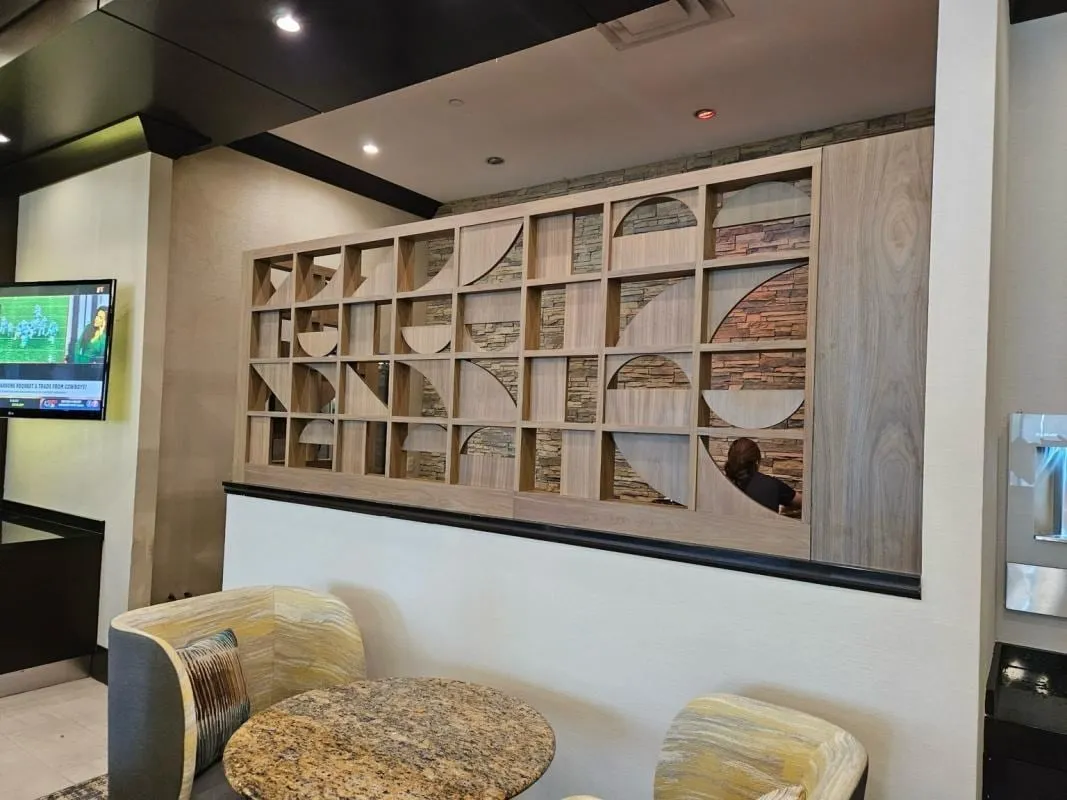
On a commercial construction project, one decision made during bidding can quietly determine how smoothly installation goes months later. Splitting the millwork into several bid packages can look like the cheaper path on paper — but it often trades a small upfront saving for coordination headaches, schedule conflicts, and costly field adjustments down the line. It’s a decision worth making deliberately, with the install in mind, not just the bid tab.
Here’s what splitting the scope actually costs, and what one coordinated package buys you.
The Hidden Costs of Splitting Your Millwork Package
- Coordination gaps. When the reception desk, the wall paneling behind it, and the counter that ties into it come from three different shops, someone has to own the transitions — the reveals, the fillers, the point where two finishes meet. That “someone” is usually the general contractor, after the pieces are already built and on site.
- Finish mismatches. “White oak, clear finish” from two different shops will not match. Different veneer lots, different stain batches, different sheen. In one space, side by side, the difference shows — and it’s nearly impossible to fix without refabricating.
- Multiplied schedule risk. Every separate vendor is a separate lead time, a separate field measure, and a separate install to sequence. One slip anywhere stalls the others, and the GC absorbs the delay.
- No single point of accountability. When a seam doesn’t line up, each vendor points at the next. With one package, there’s one shop to make it right.
The Advantages of One Coordinated Millwork Package
- One field measure and one coordinated set of shop drawings — where the commercial casework, counters, paneling, and specialty pieces are detailed to work together, not just to each other’s edges.
- Consistent material and finish across every element, from the same lot, finished in the same booth.
- One install crew and one schedule to sequence, instead of choreographing three.
- One point of contact for the whole scope — during the bid, during the build, and if anything needs attention after.
Because one shop prepares the complete shop drawing package, details are coordinated before fabrication instead of being solved in the field. That single set of coordinated shop drawings is where a custom millwork scope either comes together cleanly or starts to unravel.
For general contractors and project managers, consolidating the scope has a second payoff: fewer vendors means fewer RFIs, fewer coordination meetings, and fewer opportunities for scope disputes between trades. That’s less time spent refereeing and more time keeping the job moving.
A quick example
Imagine a reception desk fabricated by one company and its quartz countertop by another. If the counter’s overhang comes in a quarter inch off what the desk was built to carry, both vendors can argue the other caused it — while the GC coordinates a fix, holds the install, and waits on a remake. Built as one package, that overhang is resolved on the shop drawings, long before either piece is cut.
The savings from splitting a package are real until the first seam doesn’t line up. Then they’re a change order.
When Separate Packages Actually Make Sense
This isn’t an argument to force everything under one line. Truly unrelated scopes — structural steel, stone set by a stone yard, specialty metal — often belong elsewhere. The test is simple: does the item share a material, a finish, or a physical seam with the rest of the millwork? If it does, keeping it in one package almost always protects your schedule and your budget. If it genuinely doesn’t — as with some architectural millwork that interfaces with other trades — split it out deliberately, not by default.
Planning a commercial project? Send us your architectural drawings, specifications, or existing bid package, and our estimating team will review the complete scope and provide one coordinated proposal that simplifies fabrication, installation, and scheduling. Not sure your set is ready? Our guide on how to prepare drawings for a millwork bid walks through exactly what to send — or you can just contact our team to talk it through.
For more than 35 years, Pio Custom Cabinetry has coordinated commercial millwork packages to AWI Custom Grade standards throughout the Chicagoland area, helping contractors simplify complex projects with one experienced fabrication partner.
Frequently asked questions
- Should commercial millwork be bid as one package?
- In most cases, yes. When casework, countertops, paneling, and specialty items share a material, a finish, or a physical seam, bidding them as one coordinated millwork package reduces field conflicts, keeps finishes consistent, and gives the general contractor a single point of accountability. Truly unrelated scopes — structural steel or stone set by a stone yard — can still be split out.
- What is included in a commercial millwork package?
- A typical package covers architectural casework, reception desks and workstations, wall paneling and cladding, commercial countertops, and specialty or custom millwork — along with the coordinated shop drawings, field measuring, fabrication, finishing, delivery, and installation that tie them together.
- Why do commercial millwork projects get split into multiple packages?
- Usually to chase a lower line-item price or because different trades are bid separately. The trade-off is more vendors to coordinate, more lead times to sequence, and more seams where finishes and dimensions have to match in the field instead of on one set of shop drawings.
- Does one millwork contractor install everything in the package?
- With a single-source package, one shop prepares the shop drawings, fabricates the work, and installs it with one crew on one schedule. That removes the hand-offs between separate vendors and keeps responsibility for the finished result in one place.
- Can you bid from architectural drawings alone?
- Yes. Architectural drawings, a finish schedule, and specifications are enough for an accurate bid, and partial sets are fine for a budget number. See our guide on how to prepare drawings for a millwork bid for the full checklist.