
Commercial Casework vs. Custom Cabinetry
Commercial casework and custom cabinetry aren't the same thing. Here's how they differ — in purpose, cost, and lead time — and why most commercial millwork projects need both.
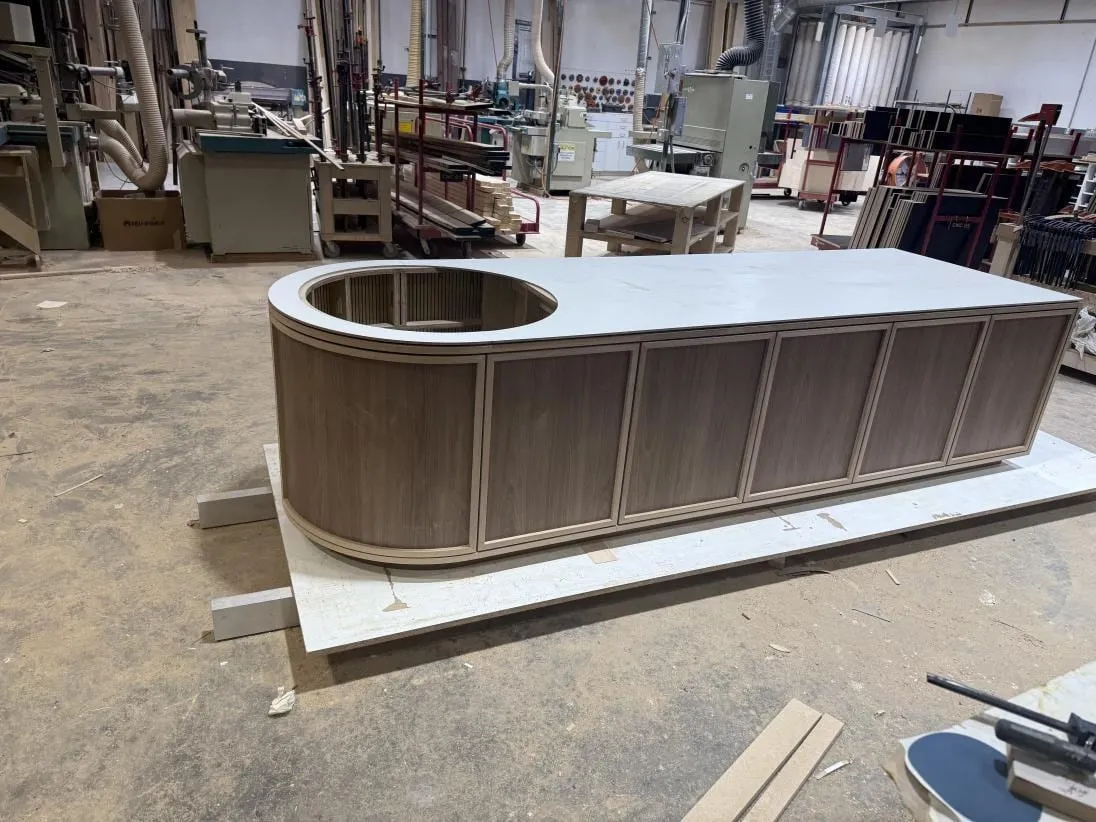
On commercial projects, “casework” and “custom cabinetry” get used interchangeably — but they’re not the same thing, and the difference matters when you’re scoping a job, setting a budget, or sending a package out to bid. One is the standardized, high-durability backbone of a space; the other is the bespoke work designed for a single room.
Here’s how to tell them apart, and why most commercial fit-outs need both.
What is commercial casework?
Commercial casework is standardized, box-based cabinetry — the base and wall cabinets, work surfaces, and storage that make a commercial space function. Think exam-room casework, break-room runs, nurse stations, workstations, and supply storage. It’s built in repeatable modules to a consistent standard (typically AWI grade), which makes it efficient to fabricate, easy to coordinate, and built to take heavy daily use.
If a space needs durable, functional cabinetry that does its job and lasts, that’s commercial casework.
What is custom cabinetry (architectural millwork)?
Custom cabinetry — often called architectural or custom millwork — is the work designed for one space and one purpose. A reception desk built to wrap a structural column. A stained-wood feature wall. A curved check-in counter, a specialty display, a boardroom credenza. These pieces aren’t pulled from a module; they’re detailed, drawn, and fabricated for a specific design intent.
This is where custom millwork and architectural millwork come in — the pieces that give a space its identity.
The key differences
Purpose
Casework is functional — storage, work surfaces, and organization that support how a space operates. Custom cabinetry is expressive — the millwork that shapes how a space looks and feels. Both are essential; they just answer different questions.
Cost and lead time
Casework’s repeatable modules are more efficient to fabricate, so per-piece it’s generally more economical and predictable. Custom cabinetry carries unique shop drawings, detailing, and material selections, which can add cost and lead time. Neither is “better value” — it depends on what the space requires.
Design flexibility
Casework prioritizes durability and consistency. Custom cabinetry prioritizes fit and design — it can follow any geometry, finish, or feature the architect specifies. When a piece has to be exactly right for one room, that’s custom work.
Why most projects need both
A typical commercial fit-out uses both, and the smartest packages plan for it. The casework handles the functional backbone — the exam rooms, break rooms, and storage — while the custom cabinetry delivers the reception desk, the feature wall, and the pieces clients actually notice.
Keeping both under one coordinated millwork package matters: it holds finishes consistent across every element, keeps the seams where casework meets custom work clean, and gives the general contractor a single point of accountability instead of coordinating separate vendors. When the reception desk and the casework behind it come from the same shop, the wood species, laminate, and finish actually match — a detail that’s surprisingly hard to guarantee when the work is split across vendors.
What it looks like across different spaces
The balance between casework and custom cabinetry shifts by project type:
- Medical and healthcare — casework carries the exam rooms, nurse stations, and supply storage, while custom cabinetry shapes the reception and check-in area that patients see first.
- Corporate offices — casework handles break rooms, copy stations, and storage walls; custom millwork delivers the lobby reception desk and any feature paneling.
- Retail and hospitality — the mix leans toward custom, where display fixtures and feature millwork carry the brand, with casework working quietly in back-of-house and stock areas.
- Education — durable, high-traffic casework fills classrooms, labs, and libraries, with custom pieces reserved for commons areas and signature spaces.
In every case, the two support each other: the casework keeps the space running day to day, and the custom work makes it memorable.
How to scope it in your bid package
When you send a millwork scope out to bid, it helps to be clear about which is which — the standardized casework runs versus the custom, made-to-fit pieces. That clarity lets the fabricator price each accurately and flag lead-time drivers early. (Our guide on what to include in a millwork bid package walks through the full checklist.)
Which does your project need?
For most commercial spaces, the answer is both — the durable casework backbone plus the custom pieces that set the space apart. The goal isn’t to choose one; it’s to scope each correctly and build them to work together.
Planning a project? Send us your drawings and scope — our estimating team will help you sort the casework from the custom work and get you a clear, competitive quote on the full package.
Frequently asked questions
- What's the difference between commercial casework and custom cabinetry?
- Commercial casework is standardized, box-based cabinetry — base and wall cabinets, work surfaces, and storage built in repeatable modules for offices, healthcare, schools, and retail. Custom cabinetry (architectural millwork) is bespoke work designed for a specific space and purpose, like a reception desk, feature wall, or specialty piece. Casework is the durable backbone; custom cabinetry is the one-off, made-to-fit work.
- Is custom cabinetry more expensive than commercial casework?
- Usually, yes — per piece. Custom cabinetry involves unique detailing, shop drawings, and materials specific to one design, while casework's repeatable modules are more efficient to fabricate. But cost depends on grade, materials, and quantity. The right question isn't which is cheaper; it's which the space actually needs.
- Do commercial projects need both casework and custom cabinetry?
- Most do. A typical fit-out uses casework for the functional backbone — exam rooms, break rooms, workstations, storage — and custom cabinetry for the pieces that define the space, like the reception desk or a feature wall. Scoping both under one millwork package keeps finishes consistent and coordination simple.
- Is 'casework' the same as 'millwork'?
- Not exactly. Millwork is the broad term for custom-fabricated woodwork in a building. Casework is a category within it — the cabinetry and storage components. Custom or architectural millwork usually refers to the bespoke, feature-level work. On a real project the terms overlap, which is exactly why it helps to define scope clearly.